COPY PASTE

Showing posts with label guar gum export from india. Show all posts

Guar Seed & Guar Gum Price Outlook 2026: NCDEX Prices, Rajasthan Crop, Exports and Market Fundamentals

Guar Seed & Guar Gum Market Outlook 2026: Prices Firm as Lower Acreage and Supply Concerns Meet a Volatile Energy Market

Guar Market at a Crossroads: Lower Rajasthan Acreage Supports Prices, but New Crop and Export Demand Will Decide the Next Move

Market Report Date: 26 August 2026

The Indian guar market has entered one of the most important phases of the 2026 season. After a sharp improvement in guar seed and guar gum prices over the past several weeks, attention is gradually shifting away from old-crop availability towards the size and condition of the crop now standing in the fields of Rajasthan.

The immediate price picture is interesting. Guar seed is trading comfortably above the levels seen earlier in the season, guar gum has moved above ₹12,000 per quintal in the physical reference market, and forward NCDEX contracts continue to command premiums. Yet the market is not moving in one direction every day. Guar gum and near-month guar seed contracts corrected on 26 August even while the broader structure remained relatively firm.

That divergence is important. It suggests that the market is no longer trading simply on a shortage story. Traders are balancing lower guar acreage and weather uncertainty against the prospect of new-crop arrivals, export demand, processor margins and a highly volatile international crude-oil market.

NCDEX Guar Market: Stronger Structure, but Some Profit-Taking Appears

The official NCDEX market snapshot supplied for 26 August 2026 shows September guar seed at an LTP of ₹6,235 per quintal, compared with the exchange spot reference of ₹6,186.15. The October contract was at ₹6,289, while November was quoted at ₹6,399 per quintal.

That means September was trading roughly ₹49, or 0.8%, above spot; October around ₹103, or 1.7%, above spot; and November approximately ₹213, or 3.4%, above the current spot reference.

This upward-sloping forward curve deserves attention. It tells us that the market is placing a higher value on guar seed for delivery further into the season. Part of that can be explained by carrying costs and contract structure, but the widening premium into November also reflects uncertainty surrounding the quantity of new seed that will become available after harvest.

The September guar seed contract slipped ₹18, or 0.29%, on the day, while October declined ₹23, or 0.36%. November, although thinly traded, was ₹28 higher. Open interest stood at 38,070 for September and 31,670 for October, showing that the two nearby contracts remain the meaningful centres of market participation.

Open interest, however, should not be read as automatically bullish. Without comparing the day's change in open interest with the price movement, it would be inappropriate to describe the activity conclusively as fresh buying or fresh short selling.

Guar gum showed a somewhat different pattern. September guar gum was at ₹11,980 per quintal, down ₹87 or 0.72%, while October was quoted at ₹12,165, down ₹89 or 0.73%. The NCDEX spot reference stood at ₹12,132.95 per quintal.

This placed September futures about ₹153 below spot, while October remained modestly above spot. The October premium over September was approximately ₹185 per quintal.

Rather than signalling a collapse in sentiment, the structure suggests that nearby guar gum was experiencing correction or profit-taking while the forward market continued to retain a premium. Official NCDEX spot data had shown guar gum at ₹11,932.60 on 12 August and ₹12,050 on 21 August, illustrating the strength that developed through the middle of the month. Guar seed spot references similarly moved from about ₹6,000 at Bikaner on 12 August to ₹6,100 on 21 August.

Guar Seed & Guar Gum Price Outlook 2026: NCDEX Prices, Rajasthan Crop, Exports and Market Fundamentals


Guar Korma Adds Another Layer to Processing Economics

Guar korma should not be overlooked when analysing guar seed prices. The September korma contract was quoted at ₹4,500 per quintal on 26 August, up ₹55 or 1.24%, while the spot reference was ₹4,533.

The strength in korma is relevant because a guar processor does not depend only on the value of gum or splits. Revenue from guar meal and korma contributes to the economics of seed crushing. A stronger feed by-product market can therefore improve the capacity of processors to pay higher prices for guar seed, even when guar gum itself experiences temporary corrections.

The relationship is best understood as an integrated processing chain: guar seed produces the endosperm used for guar splits and gum, while the germ and hull contribute to feed products. Consequently, a firm guar korma market provides an additional support mechanism to the seed market.

The Biggest Supply Story Is Now Rajasthan Acreage

The most important fundamental development is the emerging 2026 sowing picture.

Rajasthan's guar acreage reached approximately 22.35 lakh hectares by 25 August, compared with about 24.82 lakh hectares at the same stage last year, according to reporting based on Rajasthan Agriculture Department data. That represents a decline of about 2.47 lakh hectares, or nearly 10% year-on-year. Total Rajasthan kharif acreage was also lower, at 153.97 lakh hectares compared with 158.01 lakh hectares a year earlier.

This is considerably more informative than the early-season sowing numbers. On 17 July, guar had covered only about 11.53 lakh hectares, equivalent to 45% of the state's 25.50-lakh-hectare target. By around 10 August, sowing had reached approximately 15.17 lakh hectares, or 60% of target, after rainfall revived in some western districts.

The latest 22.35-lakh-hectare figure shows that farmers eventually planted substantial additional acreage, but the crop still appears to have finished below both last season's level and the official target.

For the guar market, that is a genuine supportive fundamental.

A 10% decline in area does not automatically translate into a 10% reduction in production. Yield will ultimately determine the crop size. But with acreage already lower, the margin for weather-related yield losses has narrowed considerably.

Monsoon Story Is More Complicated Than “Poor Rain Means Higher Guar”

The weather narrative needs more nuance than the usual commodity-market conclusion that a weak monsoon is automatically bullish for guar.

IMD's updated seasonal forecast released on 29 May projected all-India June-September rainfall at 90% of the Long Period Average, with a model error of ±4%. The forecast assigned an 84% probability to below-normal or deficient rainfall and indicated the transition from neutral ENSO conditions towards El NiƱo during the monsoon season.

Actual rainfall has indeed been uneven. Rajasthan had received 234.02 mm between 1 June and 10 August against a normal 267.34 mm, a deficit of 12.46%. By 21 August, the statewide deficit had widened to roughly 14.1%, with Jodhpur division reported around 23% below normal.

Yet conditions differed widely from district to district. Bikaner and Barmer had received relatively favourable rainfall earlier in August, while some other important guar-growing areas were normal or deficient. Western Rajasthan also experienced a revival of rainfall in early August, allowing delayed sowing to accelerate.

At this stage, therefore, the market needs to watch crop condition rather than rainfall totals alone.

Guar is drought tolerant, but rainfall timing matters. Moisture during establishment, branching, flowering and pod formation can influence yield significantly. A crop planted late after delayed rain may also face different yield prospects from one established within the normal sowing window.

The next weather risk is consequently less about whether guar was planted and more about whether sufficient moisture is available to carry the crop through reproductive development.


Guar Seed & Guar Gum Price Outlook 2026: NCDEX Prices, Rajasthan Crop, Exports and Market Fundamentals

Competition from Other Crops Has Clearly Influenced Acreage

Farmer crop choice is another important piece of the 2026 supply story.

Rajasthan's latest sowing data show guar acreage lower year-on-year even as bajra expanded from about 39.09 lakh hectares to 40.55 lakh hectares. The state's overall crop mix has therefore shifted rather than simply contracted uniformly.

This matters because guar competes for land with bajra, moong, moth, cotton, groundnut and other kharif crops. Farmers increasingly compare expected crop returns rather than relying on traditional acreage patterns. Where competing crops offer stronger price visibility, better procurement prospects or more predictable yields, guar can lose land.

The approximately 10% reduction in guar sowing this year suggests that guar prices at planting time were not sufficient to prevent some acreage migration.

For traders, this is potentially more important than daily mandi arrivals because acreage creates the upper boundary for the coming crop.


India Remains the Centre of the Global Guar Trade

India's position in the international guar market remains structurally powerful. APEDA states that India accounts for about 80% of global guar production, with Rajasthan contributing roughly 72% of Indian production. It also notes that around 90% of guar gum processed in India is exported and highlights oil drilling, food, paper, textiles and several other industries as major users.

There is, however, a data issue that market reports should handle carefully.

APEDA's currently published guar page displays FY2024-25 exports at 474,519.44 MT valued at US$550.12 million and identifies Germany, the United States, Russia, Norway and China among the major 2025-26 destinations.

Some trade reports circulating in the market quote approximately 475,562 MT for FY2025-26. The Commerce Ministry's TradeStat system now contains data through FY2025-26, but the easily accessible official summary pages do not independently reproduce that exact tonnage in a form that can be confidently verified from the public result alone. The TradeStat database itself confirms that full 2025-26 annual trade data are available and was updated in August 2026.

For a professional market report, it is therefore better not to present the 475,562-MT figure as confirmed official data until the relevant HS-code extraction is independently verified.

The broader conclusion remains intact: export demand is central to guar price formation. With the domestic market producing far more guar gum than it consumes, even relatively modest changes in international buying can quickly influence mill demand for guar seed.

Crude Oil Is Supportive — But Not in a Straight Line

The connection between guar gum and crude oil continues to attract trader attention because guar derivatives are used in hydraulic fracturing and other oilfield applications.

But crude prices alone are an incomplete indicator.

Brent crude settled at $88.58 per barrel on 25 August, while WTI settled at $82.36, after both benchmarks fell sharply amid easing perceptions of supply risk surrounding Iran and the Strait of Hormuz. On 26 August, Brent fell further towards the $86 area as markets reacted to negotiations involving Iran and Oman.

Those prices are still historically meaningful for drilling economics, but they are well below the levels briefly seen during the recent geopolitical escalation. This means the guar trade should not assume that every increase in crude will immediately translate into additional guar gum demand.

The better indicator is drilling activity.

Baker Hughes reported 588 operating rigs in the United States on 21 August, including 452 oil rigs and 127 gas rigs. The U.S. total was 50 rigs above the corresponding level a year earlier. Canada had 216 rigs, 36 more than a year earlier, while the international rig count stood at 1,096 in July, up 23 from June and 17 year-on-year.

That is a constructive signal for oilfield-service demand. Even though U.S. rigs fell by five in the latest week, the year-on-year comparison remains stronger.

The transmission mechanism for guar is therefore still supportive: profitable drilling encourages well development and hydraulic fracturing, which supports demand for oilfield chemicals and potentially guar derivatives. But actual export orders, frac activity and inventory held by overseas users remain more important than crude prices by themselves.

What Is the Market Really Pricing?

The emerging picture is neither aggressively bullish nor clearly bearish.

The strongest support comes from the decline in Rajasthan guar acreage, an already elevated price structure, uncertainty over final crop yields and relatively healthy international drilling activity.

The main restraining factor is that the new crop is approaching. If September weather supports pod development and productivity, the market will eventually have to absorb fresh arrivals. Farmers may also increase selling if prices near ₹6,000-₹6,300 remain attractive.

This explains why the current futures curve is particularly revealing. Guar seed contracts are pricing later deliveries at progressively higher levels, while September guar gum briefly moved below spot on 26 August. In effect, the seed market is retaining a supply-risk premium, but the gum market is asking whether end-user demand can justify the recent rally.

That distinction could decide the next major move.

Current Market Snapshot – 26 August 2026

MarketPriceDay MovementOIInterpretation
NCDEX Guar Seed Sep₹6,235/qtl-0.29%38,070Firm versus spot despite daily correction
NCDEX Guar Seed Oct₹6,289/qtl-0.36%31,670Premium reflects forward supply expectations
NCDEX Guar Seed Nov₹6,399/qtl+0.44%60Higher price but very low OI
Guar Seed Spot₹6,186.15/qtl——NCDEX reference
NCDEX Guar Gum Sep₹11,980/qtl-0.72%53,740Trading below spot after correction
NCDEX Guar Gum Oct₹12,165/qtl-0.73%25,870Premium over September
Guar Gum Spot₹12,132.95/qtl——NCDEX reference
NCDEX Guar Korma Sep₹4,500/qtl+1.24%75Feed by-product remains supportive
Guar Korma Spot₹4,533/qtl——NCDEX reference

NCDEX market snapshot source: Live NCDEX Market Watch supplied for this report; prices shown as of 26 August 2026.

Bullish vs Bearish Fundamental Assessment

Supportive Fundamentals

Downside Risks

Rajasthan guar acreage around 10% below last year


New-crop arrivals will begin approaching after harvest

Weather and yield uncertainty remain

Good September moisture could protect yields

Forward guar seed contracts trade above spot

Higher prices may encourage farmer selling

U.S., Canadian and international drilling activity remains healthy

Crude oil has corrected sharply from recent highs


Guar korma prices are providing processing support


Export demand must keep pace with elevated domestic prices

India retains dominant global supply position

Carry-over stocks remain difficult to quantify independently

Export-oriented demand structure gives upside potentialProcessor margins could tighten if seed rises faster than gum

Market Outlook: September to New-Crop Period

Base case: The most reasonable current assessment is firm but volatile. Guar seed has fundamental support from lower acreage, while the market still lacks enough information about final yield to justify assuming a major shortage. Prices may therefore remain sensitive to weather reports, crop surveys and export enquiries.

Bullish case: A sustained upward move would become more credible if field reports begin showing yield loss, September rainfall proves inadequate in major western Rajasthan districts, physical arrivals remain restricted and guar gum export orders improve. Under such conditions, the existing premium in forward guar seed contracts could widen.

Bearish case: A meaningful correction could emerge if late-season weather supports crop development, production estimates improve, farmers release old stocks or new-crop seed aggressively, and international guar gum demand fails to follow the recent increase in Indian prices. Further weakness in crude combined with falling drilling activity would add to that pressure.

The key point for investors and traders is that acreage has already supplied one bullish piece of information; yield is now the missing variable.

What Traders Should Watch Next

The market's next direction can be read through a relatively simple chain:

September rainfall and crop condition → yield expectations → Rajasthan production estimate → old-stock selling → new-crop arrivals → NCDEX spreads and open interest → processor buying → guar gum export enquiries → oilfield activity → global guar demand.

A change in any one variable may create short-term volatility. A sustained trend will require several of them to move in the same direction.

For the moment, the fundamentals justify a cautiously positive medium-term bias rather than an unrestricted bullish call. Lower acreage gives the market a real supply-side argument, but the next decisive phase will come when traders begin replacing acreage speculation with actual field-level yield and production estimates.

That transition—from sowing expectations to measurable crop size—is likely to define the guar seed and guar gum market through September, October and the arrival of the 2026 crop.

Keywords

Guar Seed Price, Guar Gum Price, Guar Seed Price Today, Guar Gum Price Today, NCDEX Guar Seed, NCDEX Guar Gum, Guar Seed Market Outlook 2026, Guar Gum Market Outlook 2026, Guar Gum Export from India, Rajasthan Guar Production, Guar Seed Sowing Rajasthan, Guar Gum Demand, Guar Market Forecast, Guar Gum Export Demand, Guar Commodity Market.

Hashtags

#GuarSeed #GuarGum #GuarMarket #GuarSeedPrice #GuarGumPrice #NCDEX #CommodityMarket #CommodityTrading #GuarOutlook #AgricultureMarket #RajasthanAgriculture #GuarExports #GuarKorma #Agribusiness #CommodityResearch #IndianAgriculture #OilAndGas #MarketOutlook #AgriCommodities #GuarIndustry

Data References

NCDEX: Live Market Watch supplied for 26 August 2026; NCDEX spot and contract reference information.

Rajasthan Kharif Acreage: Rajasthan Agriculture Department figures reported up to 25 August 2026.

Monsoon: IMD/Ministry of Earth Sciences seasonal forecast dated 29 May 2026 and Rajasthan rainfall updates through August.

Guar Exports and Industry Structure: APEDA/DGCI&S and Government of India TradeStat.

Oil & Drilling: Reuters energy-market reports, 25–26 August 2026; Baker Hughes rig data through 21 August 2026 and international count through July.

Market Disclaimer: This report is prepared for commodity-market information, research and educational purposes. Commodity prices are volatile and can change rapidly with weather, supply, demand, currency, geopolitical and speculative factors. It should not be treated as a guaranteed price forecast or individual investment recommendation. Please take your financial decision independantly as per your personal analysis and advise of your fincial consultant.

Child Labour In Guar Farming and Guar Gum Processing Industry

Child Labour In Guar Farming and Guar Gum Processing Industry

Child labour is major social problem/issue in Agriculture. In some under developed countries child labor is used for the agricultural production/ farming and further process. Some crops are labor intensive and they require extensive labor to complete the agricultural operations. Like paddy plantation, Cotton harvesting, Vegetable farming required bulk labors, Some time labor is not available or costly then child labor is used to complete the operations. Some greedy parents and contractors make a nexus and right of the child are abused, they are used to make more and more money.

About Guar 

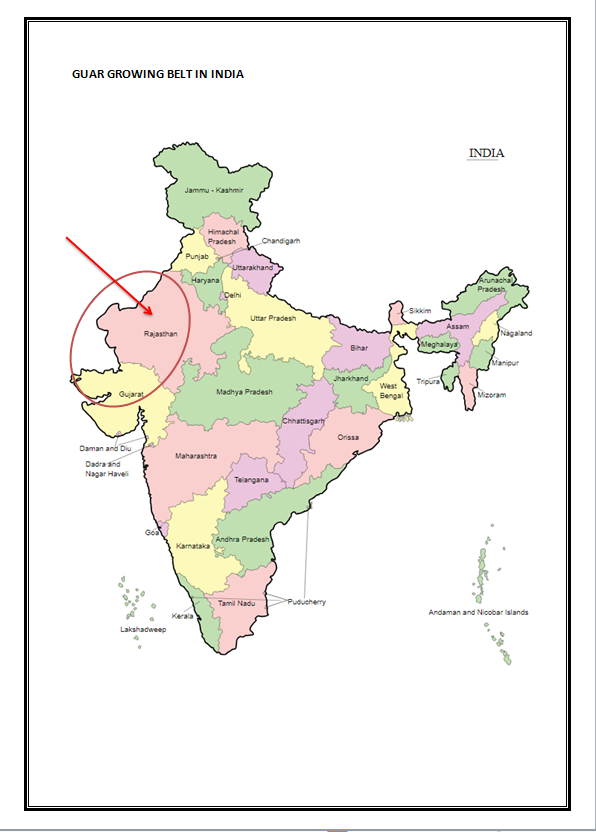
Guar is a vegetable crop traditionally grown in western Rajasthan. The Guar farming is also scattered in nearby areas of western Rajasthan, like south Punjab, south west and west Haryana, north west Gujarat and neighboring country Sindh (Pakistan). As per last year crop cultivation data Guar crop is being cultivated on 30,00,000 (3 Million) Hectares of Area. The climatic condition of this region is hot and dry. Guar crop is taken as monsoon crop or rainy period from last of June to Mid of November. 

The opportunity cost of Guar crop farming is almost zero, means farmers take the guar crop as the last option. Either he will leave his farm bran or he will take Guar crop. If the rainfall is good and on time then farmer prefers to take other crops (millets, pulses, oilseed, cereals) instead of Guar crops. As per current conditions around 95%-98% Guar farming is rain fed or based on natural rainfall only. No Artificial irrigation is given to Guar crop. Sometimes farmers give lifesaving irrigation to guar crops if he has extra water or other source of irrigation. Generally the farmers who have irrigation source or irrigation water they go for the other crop over guar crop.


Child Labour In Guar Farming and Guar Gum Processing Industry, Guar , guar gum, guar gum cultivation
Child Labor Foot Prints In Guar Farming and Guar Gum Processing Industry

Labor Required in Guar Farming and Guar Gum processing

Guar is a rain fed crop grown in desert areas. In Desert, the land sizes are very big in comparison to other areas. Mostly guar farms are very big in size. If climatic conditions are favorable then Guar farming faces a lot of labor shortage. There are various stages of guar crop cycle where labor is required to complete the operations like Sowing, weeding, Nutrients application, agrochemical application, Harvesting, Threshing, loading, unloading and transportation. Since the cropping season is the same in entire region so the timing of these operations also remains the same. The requirement of labor used to also increases suddenly at the same time.

Earlier Guar farming was completed by the Animal Drawn equipment and manually. Generally whole family used to engage in guar farming. Every family member used contributes in operation. Even Children were also involved in agricultural operations. Sometime hired labour used to also come with whole family and the child were used to engage in guar farming knowingly or unknowingly. Even these practices are also followed in some backward community and families where the numbers of Children are high. These factors will be discussed later. 

Generally child labours foot prints are not found in guar farming area and guar gum processing industry. The Scenario of child labour foot print has changed now a day. There are various factors that keep the child labour away from Guar farming.

Structure of the Guar plant (Cyamopsis tetragonoloba)

There are minor white transparent spikes on guar plant. These spikes are found on entire plant including stem, leaves, pods and branches. Generally these spikes are very soft at initial stage.  As plant mature and move toward completion of the life cycle. These Spikes become very hard and dry. As it comes in contact of skin then it start itching.  If the skin is soft specially the skin of non-labourer person or Children, then itching hurts hard. They can’t stand or stay in guar farm more than 10-15 minutes if the skin is exposed to guar plant. The itching will keep continue for whole day. Children in guar farming area knows this property and they dotn enter in guar farm. No parent wants that their children should go in Guar farm. Even hired labour doesn’t prefer to do take labour work in Guar farm. The skin of farmers are harder so they feel lesser itching. Even regular guar farmers enter in Guar farm with complete cover. Guar plant itself asks non farmer and children to keep away.

Guar Growing Belt in Rajasthan, Haryana, Punjab, Pakistan

Lesser Number of Children 

Earlier there were more children so a group of children used to go to farms but now the number of children has dropped to 2-3. Due to lesser number is children, Farmers take care their children properly and they don’t want that their children leave their study/school and go to farm with them. Scenario has changed, children goes to school regularly and stay away from working in Guar fields.

Guar Farms are larger in size

Guar Filed are very big in size and production is lower in rain fed farms. Children can’t work in big farms. It required a full capacity labour. Since size of farm is big children can’t work properly and they make more wastage while working. Due to big farm it is very hard to collect all the wastage. When the farms are small or crop is densely cultivated then any one can’t work in field. But in guar farm if unskilled worker work then he makes a lots of losses.

Lesser Farm operations

In guar farming the farming operation is lesser in comparison to other crops. So the requirement of the labor is not frequently. After the sowing labor is required at the time of harvesting. Harvesting can't be completed by the children. Because of the itching caused by the guar plant no one goes to guar farm at the time of harvesting except skilled labors. Even at the time threshing of seeds the duct contains the spikes and no one goes close to threshing sites

Use of Mechanical Agricultural implements 

Earlier farmers used to do the guar farming by manually or animals but now they use tractors and machines. Tractors and machines are more efficient. Even there is shortage of the labor and labor is not efficient in guar farming. For the sowing there are tractors, For agrochemicals there are spray machines, for harvesting there are harvesting machine / combine, for threshing there are threshing machines. Transportation is done by the tractors. The dependence on hired labor is going down day by day.

Guar Growing Belt in Rajasthan, Haryana, Punjab, Pakistan

Automatic Guar Gum Processing plants

Guar seed is first processed to the guar splits. After that they process the guar splits into the guar gum power. Guar gum powder is further processed into some modified guar gum powder. Previously guar processing industry was manual, a lot of labors were required but now things have changed. The plants have turned to fully automatic plants; some plants are PLC based plants. Labor requirements for these processing plants are very low. These plants require only highly skilled professionals. There are no possibilities of child labor foot prints in these guar gum processing plants.

Awareness of community,

Except few backward communities most of guar farmers come from progressions communities. They are all aware about the drawback of child labor. They don't employ the child labor. Guar farming is not a year around job opportunity. People/labor avoid working in guard field. 

Conclusion 

The entire value chain of guar is child labor free. In general no foot print of the child labor is noticed. Generally farmers in Guar growing belt are progressing and they give importance to child education over the labor work. The results of this mind set are also visible. Most of children of these farmers are taking higher education. After the education they prepare for competitive examinations and get selected for the well paid government Jobs.

In some backward religious communities which have more numbers of children due to illiteracy they follow the practices of Child labor the entire farmer's family member keeps working if agricultural farms. This type of under-educated religious community lives in Barmer, Jaisalmer and Jodhpur Districts. Their religious leadership orders them to attend the religious education system. Government and private organizations must create awareness about eradication of child labor in agriculture. 

Guar seed and guar gum is giving return in short term trade.


Guar seed and guar gum are major tradable agriculture commodity at NCDEX. Guar is also known as cluster bean as guar pods fruits in clusters on branches. Botanically / scientifically guar is known as Cyamopsis tetragonoloba. Guar gum powder is an important industrial product used for various application in many industries. During this week Guar gum price and Guar seed prices has fallen drastically at lower level, of current cropping season in future trading at NCDEX. In physical market Guar and Guar gum prices are stronger than NCDEX guar price and NCDEX Guar gum price. Spot prices of Guar gum are stronger than the future prices of NCDEX guar Gum. Farmers and traders were expecting the better prices with decreasing arrival and increasing export demand. But NCDEX Guar and NCDEX Guar gum prices are falling against the positive fundamentals.


This year Guar seed farmers and guar gum exporter were expecting better return due to limited supply of guar seed and good demand of guar gum. Rate of guar seed has not crossed the level of INR 4900/ 100 Kg. Prices of Guar gum and guar gum has fallen very low and touched the lowest level of this season. But in-depth analysis we see that prices are moving up and down regularly. Prices has gone up and then fallen, again gone up and fallen again. Any buying at lower level after price fall has given good return. 

Guar seed and guar gum is giving return in short term trade. , Guar, guar gum, guar price, guar gum price, guar demand, guar gum demand, guar seed production, guar seed stock, guar seed consumption, guar gum cultivation, guar gum cultivation in india, Guar gum farming, guar gum export from india , guar seed export, guar gum export, guar gum farming, guar gum cultivation consultancy, today guar price, today guar gum price, ग्वार, ग्वार गम, ग्वार मांग, ग्वार गम निर्यात 2018-2019, ग्वार गम निर्यात -2019, ग्वार उत्पादन, ग्वार कीमत, ग्वार गम मांग, Guar Gum, Guar seed, guar , guar gum, guar gum export from india, guar gum export to USA, guar demand USA, guar future price, guar future demand, guar production 2019, guar gum demand 2019, guar, guar gum, cluster beans, guar gum powder, guar gum price, guar gum uses, ncdex guar, guar price, guar gum price today, cyamopsis tetragonoloba, ncdex guar gum price, guar beans, guar rate today
Guar Seed and Guar Gum price movement in India- 2018-2019
Next four months February, March, April and May will be very Crucial for guar seed and guar price trends. If the guar prices will remain at higher side, then it will lead to increase the sowing area of Guar. If the price of guar seed and price of guar gum will remain toward the lower side, then the sowing area of Guar will come down further. With falling prices people are discussing that application of guar gum substitute has increased in oil and natural gas industry. This is not true. Oil drilling activities in USA are higher than previous year. 1075 Oil rigs are active in USA as on 11th January 2019, which are 136 higher than previous year. Guar gum emerging as Xanthan gum replacement.


Guar seed and Guar gum commodities are being quoted strong in physical markets due to strong buying of of guar gum. Prices of Guar seed and Guar gum both are quoted stronger than previous close. Forward price of Guar seed and Guar gum are also strong due to buying at lower levels in NCDEX. Bold quality of guar seed is traded at Rs 4300/100Kg and average quality normal guar seed is traded at Rs 4200/100 Kg. Standard quality guar gum is traded at Rs 8400/100 kg. In interior location, guar seed is traded up to 4100/100 Kg. Guar seed is being quoted high in the future market. At NCDEX (National Commodity & Derivatives Exchange Ltd) guar seed-10MT is closed at Rs 4152, 4207, 4262 higher by 0.25 percent or INR 10.5/100 Kg, 0.25 percent or INR 10.5/100 Kg, 0.48 percent or INR 20.5/100 Kg with open interest of 10660, 114700, 10590 for January, February and March month contracts.


Guar gum is being also traded strong in the future market. At NCDEX (National Commodity & Derivatives Exchange Ltd) Guar gum- 5MT closed at Rs 8180, 8240 higher by 0.59 percent or Rs 48/100Kg, 0.06 percent or Rs 5/100Kg with an open interest of 1380, 70005 for January and February month contracts.

Guar gum demand will remain strong in last quarter 2018-19


Guar gum demand will remain strong than previous year. India has exported 3,30,978 MT guar gum by the end of October month. Guar is major exportable farm commodity form India. Major demand of Guar arises from Oil and natural Gas industry. Crop is cultivated from June to October and major arrival of crop starts to come from October to January. This year production of Guar seed as lower than was previous year. As per the Agriculture Department of Govt of, This year guar seed was cultivated on 34,18,000 Hactare area. As per market man average Yield of Guar seed in Rajasthan is around 250 Kg / hectare. As per these inputs Total production of Guar will be between 80,00,000 – 90,00,000 Bags. 


Guar gum is used in the oil drilling activities in USA. As per the baker hudge rig count Oil drilling activities are increasing in USA. Currently 1075 oil rigs are active in USA. Which are 151 more than the previous year. Shel oil production is increasing in USA. Demand of heating oil and Gas remains high in Cold countries of northern globe. Shale oil and gas production will increase in USA and Canada. Oil and gas exploration in south American countries are increasing and export of Indian guar gum is also increasing in south American countries. 

Guar gum demand will remain strong,Guar, guar gum, guar price, guar gum price, guar demand, guar gum demand, guar seed production, guar seed stock, guar seed consumption, guar gum cultivation, guar gum cultivation in india, Guar gum farming, guar gum export from india , guar seed export, guar gum export, guar gum farming, guar gum cultivation consultancy, today guar price, today guar gum price, ग्वार, ग्वार गम, ग्वार मांग, ग्वार गम निर्यात 2018-2019, ग्वार गम निर्यात -2019, ग्वार उत्पादन, ग्वार कीमत, ग्वार गम मांग, Guar Gum, Guar seed, guar , guar gum, guar gum export from india, guar gum export to USA, guar demand USA, guar future price, guar future demand, guar production 2019, guar gum demand 2019
Guar gum demand will remain strong.
Demand of Indian Guar and Churi Korma is also high from China due to trade ware between China and USA. Prices and Demand of Churi Korma is high in market. There is 48-52 % protein content in Guar Churi Korma. Guar protein is used as substitute of Soya meal and Soya protein. 

Guar seed and Guar gum commodities are being quoted strong in physical markets due to strong export demand of guar gum. Prices of Guar seed and Guar gum both are quoted higher then previous close. Forward price of Guar seed and Guar gum are also strong due to buying at lower levels in local markets. Bold quality of guar seed is traded at Rs 4400/100Kg and average quality guar seed is traded at Rs 4300/100 Kg. Standard quality guar gum is traded at Rs 8650/100 kg. In interior location, guar seed is traded up to 4200/100 Kg. Guar seed is being traded strong in the future market. At NCDEX (National Commodity & Derivatives Exchange Ltd) guar seed-10MT is closed at Rs 4348, 4394, 4445 higher by 0.24 percent or INR 10.5/100 Kg, 0.26 percent or INR 11.5/100 Kg, 0.58 percent or INR 25.5/100 Kg with open interest of 45160, 87190, 4730 for January, February and March month contracts. 


Guar gum is being also traded strong in the future market. At NCDEX (National Commodity & Derivatives Exchange Ltd) Guar gum- 5MT closed at Rs 8608, 8718, 8810 higher by 0.34 percent or Rs 29/100Kg, 0.5 percent or Rs 43/100Kg, 1.33 percent or Rs 116/100 Kg with an open interest of 11675, 65050, 980 for January February and March month contracts.

8923 MT more guar gum has exported from April-2018 to Nov-2018 than previous year.


As per the data released by the Agricultural and Processed Food Products Export Development Authority (APEDA) Indian has exported 330978 MT guar gum. Values of guar gum export fromApril-2018 to November-2018 is INR 3052 Crore or USD 442 Million at the rate of USD1335 / MT. Previous year during the same period India exported 322055 MT guar gum. Value of exported guar gum powder was INR 2589 Crore or USD 401 Million at the rate of 1246 USD/MT. This is very positive news for Indian guar gum industry. Export of Guar gum powder is increasing continuously since last four years.


Export of Indian guar gum is increasing with increasing oil and gas drilling activities. Shale crude oil and natural gas production is increasing. Traditionally Saudi Arabia was the leader of crude oil production and Qatar was leader of Natural gas production. Now USA has become the new leader of crude oil and Natural Gas production. USA is using fracking / hydraulic fracturing activities for shale oil and gas production. Guar gum powder is used as drilling chemical in this process. USA, Norway, China, Netherland, Russia, UK, Germany, Italy. Argentina are major destination for export of Indian Guar gum. In monetary term India has exported guar gum of 17.93 % more value in Indian rupees and 10.10% more value in USD in comparison to previous year for the same period.

8923 MT more guar gum has exported from April-2018 to Nov-2018 than previous year, Guar, guar gum, guar price, guar gum price, guar demand, guar gum demand, guar seed production, guar seed stock, guar seed consumption, guar gum cultivation, guar gum cultivation in india, Guar gum farming, guar gum export from india , guar seed export, guar gum export, guar gum farming, guar gum cultivation consultancy, today guar price, today guar gum price, ग्वार, ग्वार गम, ग्वार मांग, ग्वार गम निर्यात 2018-2019, ग्वार गम निर्यात -2019, ग्वार उत्पादन, ग्वार कीमत, ग्वार गम मांग, Guar Gum, Guar seed, guar , guar gum, guar gum export from india, guar gum export to USA, guar demand USA, guar future price, guar future demand, guar production 2019, guar gum demand 2019
Export of Guar gum from India , Data of 2018-19 is only up to November-2018 ( 8 months) 
                                                                     (Source APEDA- Ministry of Commerce and Industry)

As per existing trends it is estimated that this year quantity of Guar gum export will cross the figure 6,00,000 MT. This will be very positive trend for Indian Guar gum industry and Indian guar gum seed farmers. This year Guar seed production is lower than previous years. As per Baker Hughes Rig Count ,1083 Rigs are active in USA which are 154 more than previous years rig count at the same time. Rig count is as indication of demand of drilling services and chemicals. 


Guar seed and Guar gum commodities are being traded strong on physical markets due to strong export demand of guar gum. Prices of Guar seed and Guar gum both are quoted higher then previous close. Forward price of Guar seed and Guar gum are also strong due to buying at lower levels in local markets. Bold quality of guar seed is traded at Rs 4300/100Kg and average quality guar seed is traded at Rs 4200/100 Kg. Standard quality guar gum is traded at Rs 8400/100 kg. In interior location, guar seed is traded up to 4100/100 Kg. Guar seed is being traded strong in the future market. At NCDEX (National Commodity & Derivatives Exchange Ltd) guar seed-10MT is closed at Rs 4350, 4393, 4439 higher by 2.38 percent or INR 101/100 Kg, 2.48 percent or INR 106.5/100 Kg, 2.53 percent or INR 109.5/100 Kg with open interest of 81930, 66230, 1880 for January, February and March month contracts. 


Guar gum is being also traded strong in the future market. At NCDEX (National Commodity & Derivatives Exchange Ltd) Guar gum- 5MT closed at Rs 8572, 8669, 8572 higher by 2.99 percent or Rs 249/100Kg, 2.95 percent or Rs 248/100Kg, 0.6 percent or Rs 51/100 Kg with an open interest of 28430, 47375, 330 for January February and March month contracts.

Export of Major Agriculture Commodities from India 2018-19 ( April to November only )

MATCHED CONTENT / SIMILAR NEWS